
Note: This page contains content and documents (including PDF) that have been automatically translated using Deepl.

FAQ category: 10 Combination and partial study programmes

A combined study programme exists when students “select individual courses from a larger number of courses permitted for the program” (Section 32(1) MRVO; see also Section 32 in its entirety). These courses each constitute a partial study programme within the combined study programme. Students thus typically choose two or three subjects; it is less common to have more than three mandatory subjects.
The scope of the partial study programmes to be selected within a combined study programme varies; two structural models are common: A combined study programme may consist of two partial study programmes of equal size, or it may combine one larger partial study programme with one or more smaller partial study programmes. In the latter case, the terms “major and minor” or “Major/Minor” are sometimes used. However, this should be distinguished from degree structures consisting of a single study programme with integrated, elective minors. For a distinction between combined study programmes with partial study programmes and study programmes with integrated minors, see FAQ 15.3.

Figure 1 illustrates the structure of combined study programmes in comparison to study programmes with integrated minors; Figure 2 provides examples of the two common structural models.
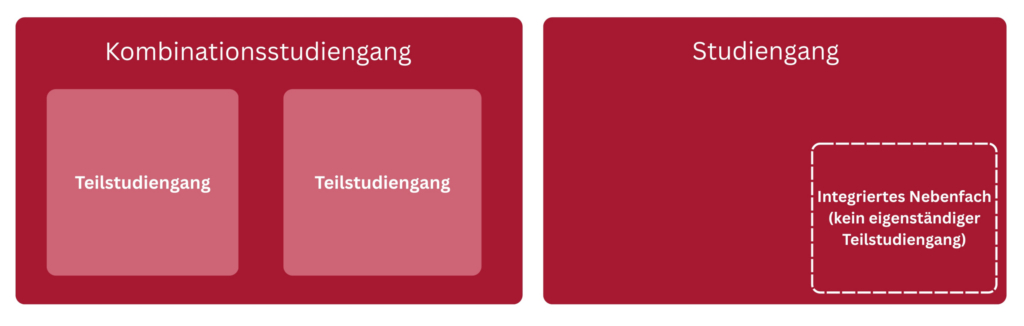
Figure 1: Combined Study Programme vs. Study Programme with an Integrated Minor
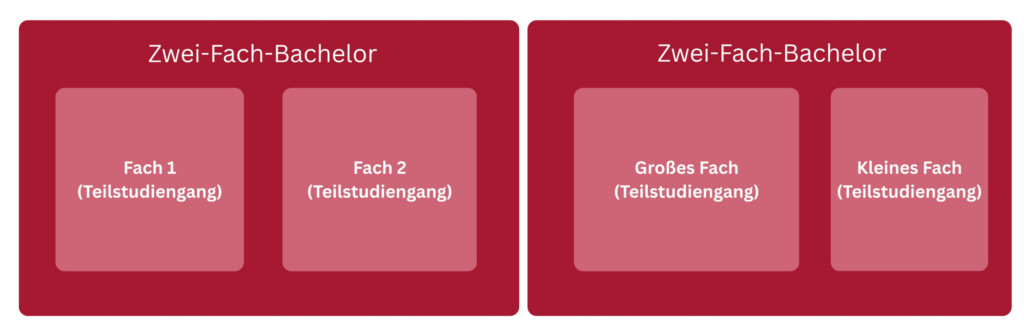
Figure 2: Examples of structural models for combined study programmes

Note on the publication date: FAQ 10.1 published in August 2018 has been merged into the new FAQs 10.1-10.5.
In the accreditation of combined and partial study programmes, the subject of accreditation is always the combined study programme (§ 32 para. 2 MRVO). This is regarded as a “shell” into which various partial study programmes are “accredited”. Accreditation decisions are made for each combined study programme as well as for the associated partial study programmes.

For the accreditation of a combined study programme, the higher education institution must prove that a coherent concept integrating the qualification goals of the partial study programmes exists for the entirety of the combinatorial offer and that the ability to study is basically guaranteed for all possible combinations (cf. justification for § 32 MRVO).

In the accreditation process, care must be taken to ensure that all contents of the combined study programme and partial study programmes are considered. This also includes course content that may belong directly to the combined study program (e.g. optional area, internships or educational sciences for teacher training programs, see FAQ 10.3 below). At the same time, central or common content of the combined and partial study program does not have to be assessed multiple times in the accreditation report.

Generally, yes; for special cases, see the end of this FAQ. Combined study programmes are common in teacher training for all types of teaching positions, for example as versatile two-subject bachelor’s programmes or as combined bachelor’s and master’s programmes in elementary school teaching, high school teaching, etc. The subjects that can be studied include German, mathematics, art, physical education, etc., and these generally also constitute the partial study programmes. It should be noted that the subject German can be offered as a partial study programme in German within the combined study programme for teacher training at elementary schools and also as an additional partial study programme in German within the combined study programme for teacher training at high schools. For programme accreditation, a separate application must be submitted in ELIAS for both partial study programmes within the respective combined study programme; internal accreditations must be entered in ELIAS for both partial study programmes in the same manner.

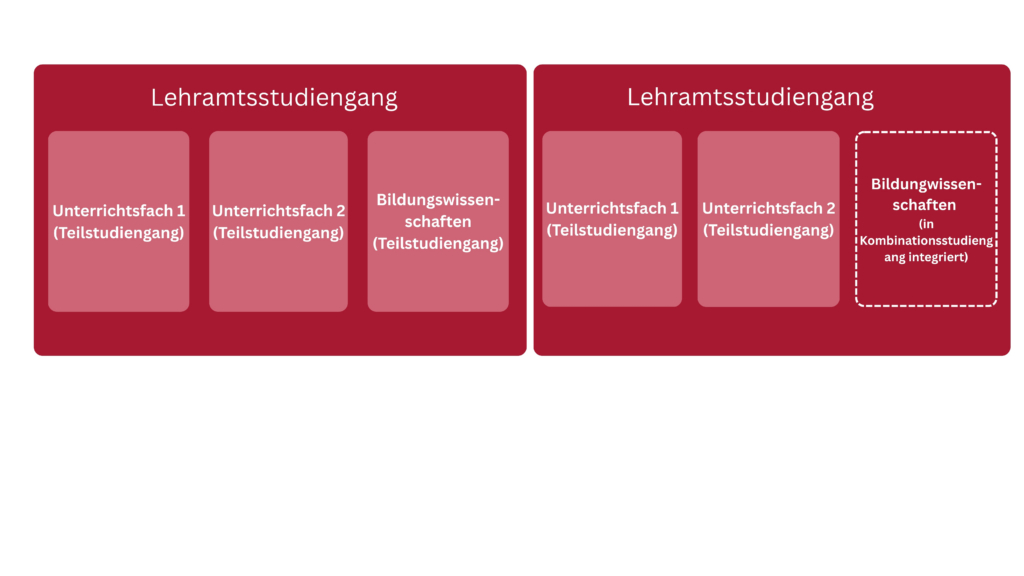
In teacher education programs, students study not only the subjects they will teach but also other fields of study, such as educational sciences. Depending on how the program is structured, these may be organized as partial study programmes or integrated into a combined study programme.

Further information, in particular on the accreditation of teacher training programs, can be found in the handout Promoting quality development through accreditation – a look at teacher training study programmes (Drs. AR 82/2022).

Figure 3 shows two examples of the structuring of various combined study programmes into partial study programmes in teacher training.

Figure 3: Examples of various combined study programmes in teacher training (non-exhaustive list)

The regulations in § 32 MRVO are intended to ensure that each combined study programme is regularly accredited every eight years (§ 26 para. 1 sentence 1 MRVO). In contrast, partial study programmes are not subjects of accreditation in their own right, but can only be accredited as part of combined study programmes. If the accreditation of the combined study programme expires or if the accreditation of the combined study programme is denied, the partial study programmes accredited as part of this combined study programme are no longer accredited. A partial study programme is therefore only accredited if both it itself has been assessed and the associated combined study programme has been accredited. This applies equally to program accreditation procedures and the internal procedures of system-accredited higher education institutions.

The MRVO does not contain any information on the validity of deadlines for partial study programmes. Therefore, an assessment period for partial study programmes is assumed to be different from the accreditation period for (combined) study programmes: Partial study programmes have an assessment period, combined study programmes have an accreditation period. Each partial study programme must be reassessed after eight years at the latest, as the provisions of Part 4 of the MRVO remain unaffected in accordance with § 32 Para. 5 MRVO.

The assessment deadlines for partial study programmes can run parallel to the accreditation deadline for the associated combined study programme, but they can also deviate from this in cases in which further partial study programmes are to be set up after the accreditation of the combined study programme and “accredited into” the existing combined study programme, see FAQ 10.6.

In the accreditation of combined study programmes, the assessment of partial study programmes can extend over several semesters. This can result in planning challenges. In the following, tips are given with regard to program accreditation that can be transferred to the respective internal accreditation processes of system-accredited higher education institutions:

  • In principle, the combined study programme should be assessed first in the course of accreditation, as the coherent concept for the entirety of the combinatorial offer is considered (see FAQ 10.2)
  • For the concept or initial accreditation of a new combined study programme, applications can be staggered and it is sufficient to first submit the accreditation application for the combined study programme together with a first subject or sub-programme bundle. The accreditation applications for the remaining partial study programs can also be submitted later. Of course, the same accreditation procedures can also be used for reaccreditations, provided that the assessment deadlines for the partial study programmes submitted later are met.
  • The possibility of staggering the application for combined and partial study programmes means that higher education institutions that offer a wide range of partial study programmes can thus streamline the implementation of accreditation.
  • Due to such a staggered application, the accreditation period of the combined study programme can begin before the assessment period of the partial study programmes, and the assessment periods of partial study programmes can also be staggered if the application is staggered accordingly (see also the previous FAQ 10.4).
  • For reaccreditation, the application for the combined study programme must be submitted in good time before the expiry of the accreditation deadline. In the case of partial study programmes, an application is only timely if it is submitted before the end of the respective review period.

Further information on the calculation of deadlines can be found in FAQ 01.2 for initial accreditations and FAQ 01.6 for reaccreditations.

If, for example, partial study programmes with different assessment deadlines are to be reaccredited together in a bundle, the option of deadline extension can be used in the course of preparing a bundle procedure; this option can also be used if there are different accreditation and assessment deadlines for combined and partial study programmes (see FAQ 04 on the necessary requirements).

§ Section 32 para. 3 MRVO stipulates that the accreditation of a combined study programme can be supplemented by the inclusion of further optional partial study programmes or subjects without changing the accreditation period for the combined study programme. This regulation is intended in particular to prevent the subsequent inclusion of further partial study programmes from being used as an opportunity to extend the accreditation period for the entire combined study programme.

An example: The combined study programme “Teacher training at grammar schools” is accredited for a period of eight years from 01.10.2020 to 30.09.2028; however, on 01.10.2024, the subject “Computer Science” will be launched as a new partial study programme as part of this combined study programme. Its review period would then run for eight years from 01.10.2024 to 30.09.2032 if the application is submitted on time. The accreditation of the combined study programme will continue to expire on 30.09.2028, even if the review period for the new partial study programme is set until 30.09.2032.